

why so glum?
Crocus sightings, hating Tàr, and surviving the part of songwriting where it feels like everything you write is terrible

I have promised only to write you when compelled to, and of all the promises minted over the winter, this one stuck
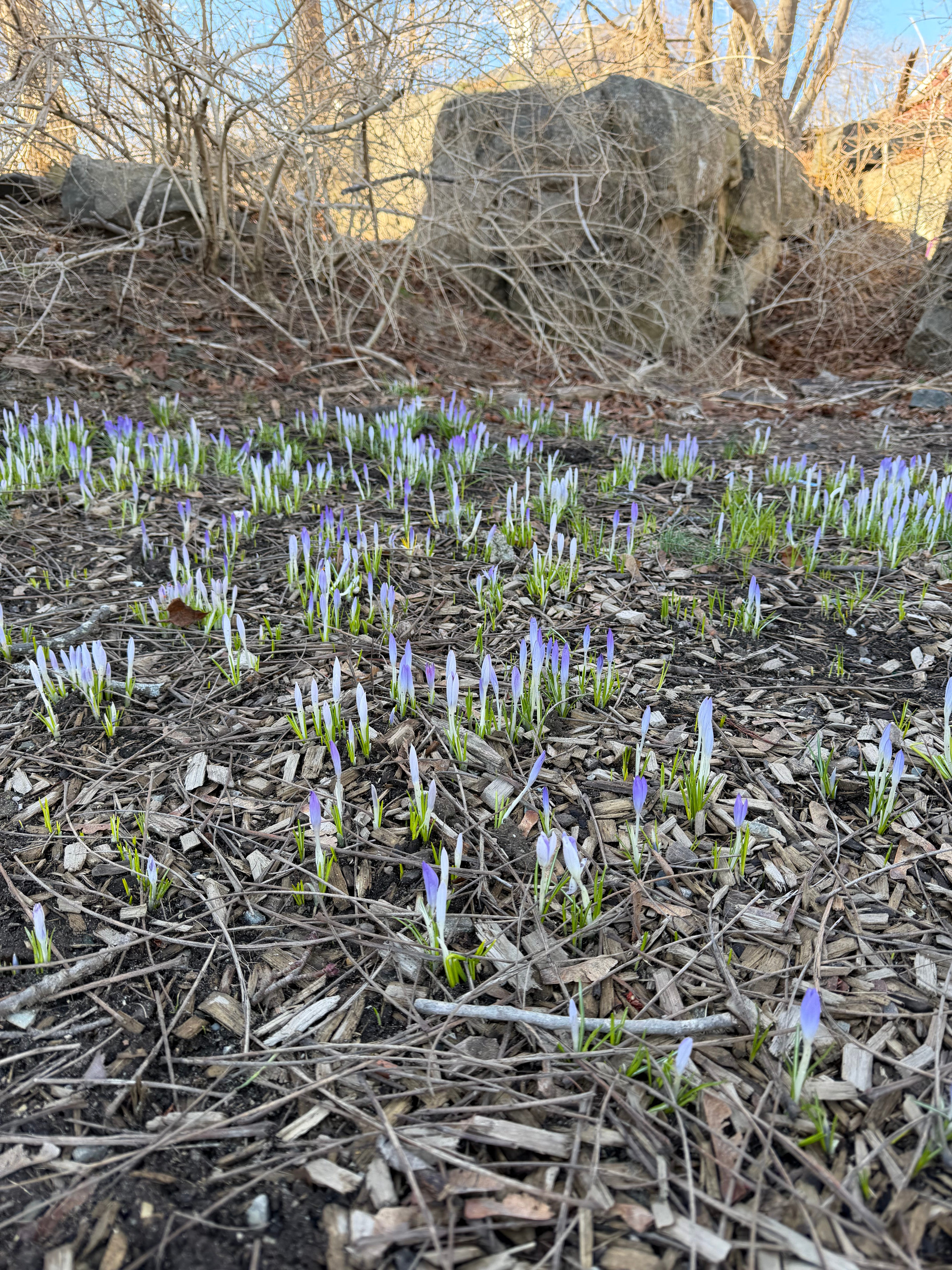
Then I saw these crocuses outside the farmstand this morning and knew I had to tell you about them. A big carpet of them springing up through the mulch. We’ve had snow on the ground for the better part of the last two and a half months, but this week most of it gave way and once I saw those purple throats pushing through, I had all the confirmation I needed. A new season on the march.
My stated objective was to lay low, so I have. I shoveled snow. I read Olivia Laing’s dishy Silver Book, which I loved, and Zadie Smith’s Dead and Alive, which includes her Pulitzer-Prize-nominated essay The Instrumentalists. That one persuaded me to give Tár a second chance. Smith analyzes the film less as a #MeToo story flipped on its head and more as a tale of generational divide — Gen X running headfirst into millennial and Gen Z ideas about art, power, and morality. It’s a compelling case, but I wish I’d stuck to my guns. It’s a drab movie, and I’m not just referring to the brutalist concrete-on-concrete interiors. Not even Cate Blanchett or the sight of Olafur Eliasson’s ‘National’ career lamp spark joy for me — only perturbance.
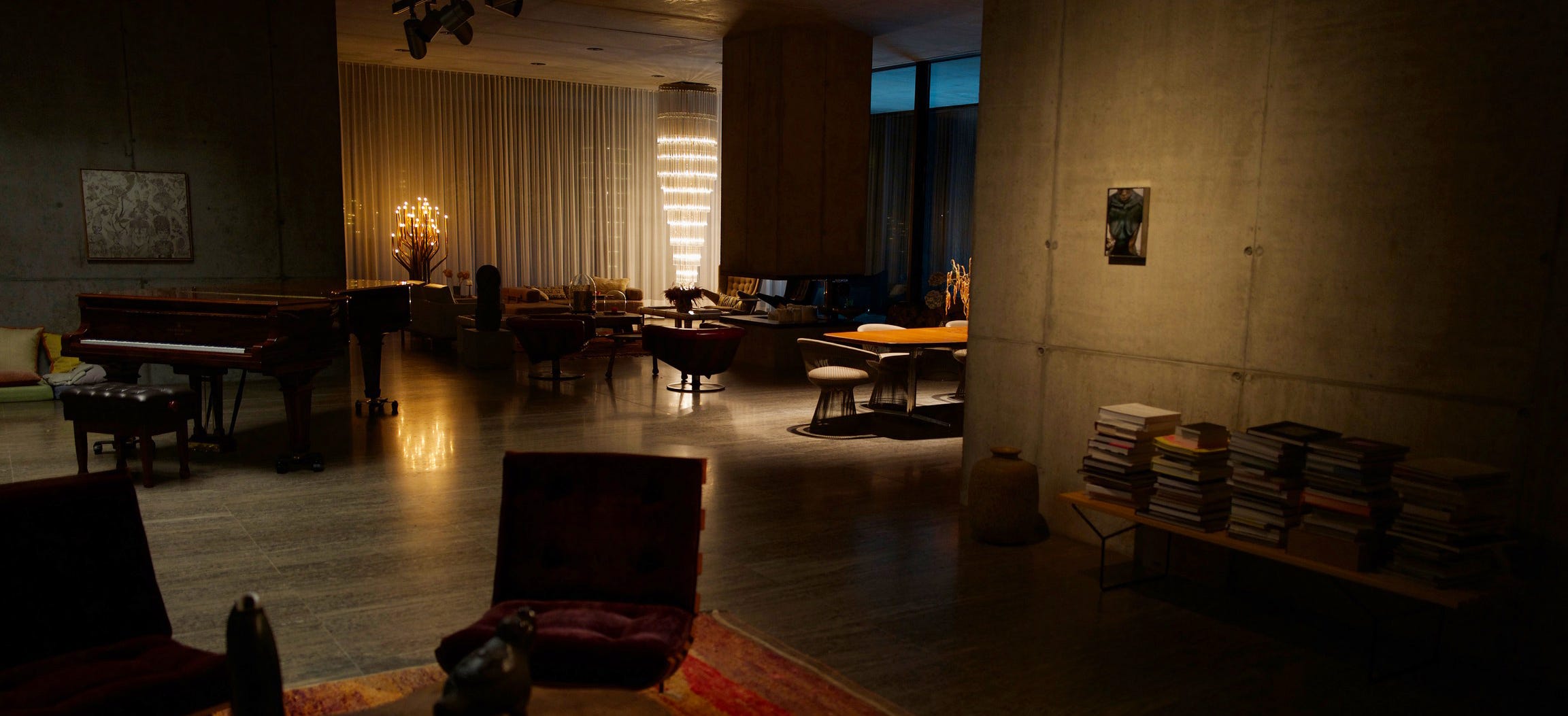
I held off on viewing the film until now because I went to a school not unlike the one it depicts, where old and new worlds collided all the time, if not quite as theatrically. Watching it, I recognized Lydia Tár as an avatar for the institution itself — the self-appointed duty to protect and defend the canon, and decide what counts as serious. I remember one composition teacher dismissing a student for a choice to employ dissonance by saying he could “break the rules like Stravinsky when you’re as good as him.” This was in 2003, nearly a century after The Firebird premiered. It felt like many of my peers were into serialism and the post-minimalism of Steve Reich, and I was into writing my little piano songs. Another declared nothing in popular song after the Beatles’ White Album was of theoretical interest to him. It felt stifling to me then. My impression of classical conservatories was that they were less a place to reckon with the future than to study, revere, and uphold the past.
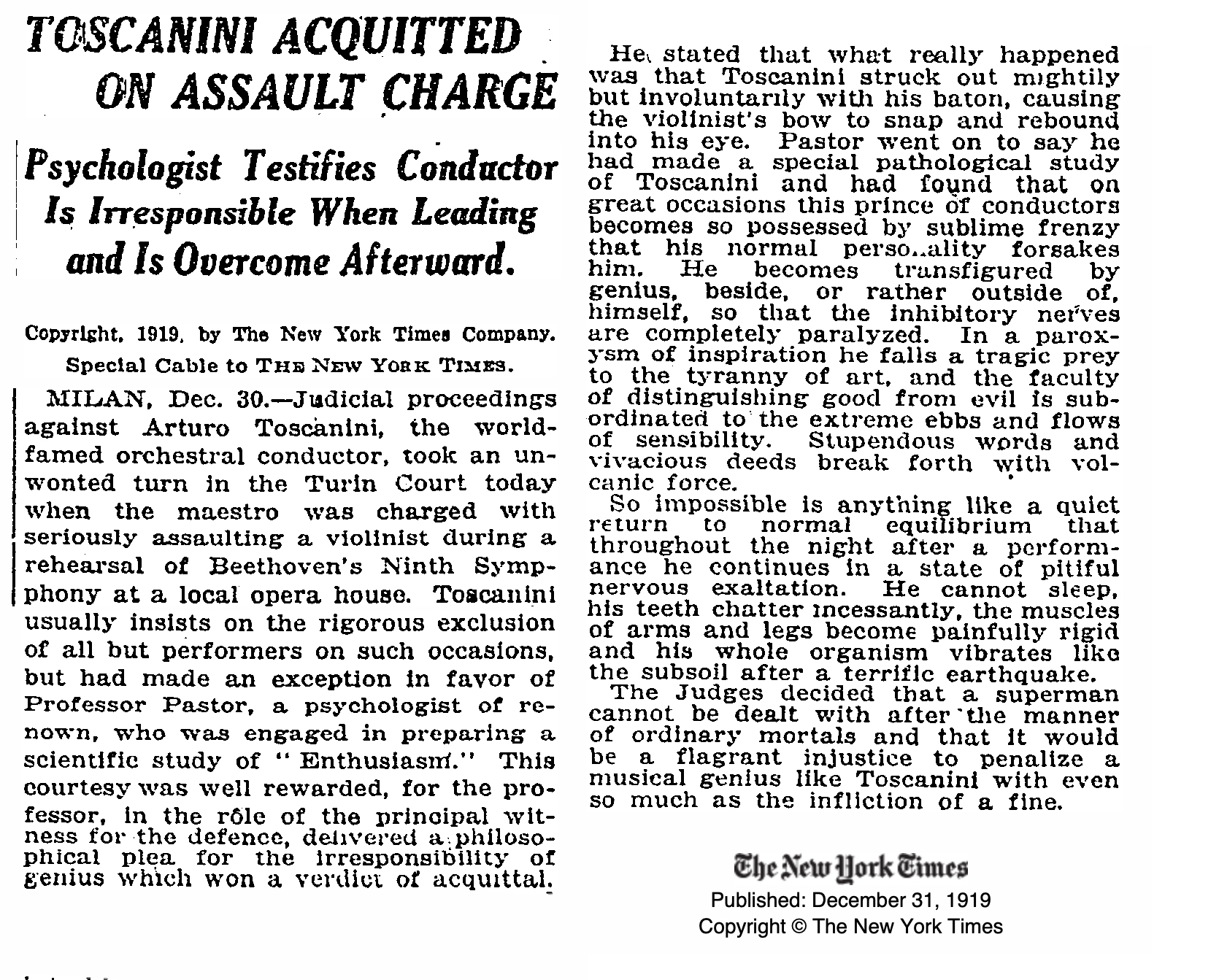
I’m bored with Art Monsters, anyway. Both reading about the justification for them, and the work they make. Maybe if I’d read Smith’s essay a few years ago I’d have been in a more open state of mind. Lately the idea that powerful people actually face consequences feels more like a fantasy. It was the great Maestro’s Toscanini’s genius, afterall, that assaulted the violinist. Not the Maestro himself.
It’s stupid thrills I want. Can’t we have more sapphic stories that are as lustful and giddy as Heated Rivalry? I crave a show about the U.S. Women’s Soccer Team where players crush on each other for years, finally do something about it, and nothing terrible happens to either of them. Thankfully, from the sound of things, my moms Sue Bird and Megan Rapinoe are on top of it.
I found myself on an accidental iPhone sabbatical after it was stolen on a layover. Once the blunt complications of traveling without two-factor authentication subsided, I felt lighter without it. Less chatter from the apps. Head up in the world instead of down. I’m never without a notebook, and I filled one up — not with anything especially deep, mind you, but my mind was on. I felt awake and alert, not as drained at the end of the day after staring at a screen. People of the world who know how much I love them, please take this in stride: I especially liked being less available at all hours and time zones.
In spite of my reluctance to plug back in once I was stateside, I buckled for work. According to Find My, my old phone had traveled a good distance — from Schiphol to a suburb outside Brussels to a strip mall in Mobile, Alabama. We’d had a good run, that phone and I. It was a replacement for one that slid out of my back pocket into the ocean on a date. I demoed most of the last album on it. Godspeed, bricked phones past. I would like to live in a world without you altogether, and I think I may spend more time this year working toward that goal. If any of you have made progress with a dumb phone or a Nothing Phone, hit me up.
And it feels like spring can’t come fast enough. Looking back at some recent posts, I detect a glumness — and honestly, how could one not feel a little under the weather about where this big blue marble of ours is headed? Much of it feels out of our control. But I’m not writing to you about those worries today.
A lot of my mood stems from struggling with the blank slate
I need momentum, or inertia kicks in. Like early spring, when the snow melts but nothing grows yet and the ground just feels heavy and stuck. It’s a feeling of uselessness, but also emptiness. I’ve never found a way around it except to steer directly through the center.
It comes from a good place. Like a lot of creative people, ideas get me out of bed in the morning. I’m at my best when I have that charge to work with, or an insurmountable mountain to move. I like the unset-Jell-O sensation that comes with a riddle. Confronting myself with a texture that’s new, unfamiliar, or a little daunting turns me on — any kind of resistance, really. It’s the same with a workout. I don’t want it to be easy. I want to push myself outside my comfort zone. I need something solid to throw my energy against or I get bored. When I’m bored, that’s when I’m most likely to tap out.
But boredom is something I’m working to stay with. The moment right before something new finds its way rarely feels exciting. I generally have to sit with months-long dry spells before that happens, but sometimes these extend for years. If life is what happens while you’re busing making plans, songwriting’s what happens while you’re busy trying to make a life.
I’ll get one piece that’s interesting, but sometimes seventy percent of the rest feels bland or rehashed, and my first instinct is to assume I’m out of ideas. When I was in my 20s, these periods felt existential. I would never write a song ever again. The fact that I’d managed to write dozens in the past did not occur to me as a data point worth considering. It must have been that I was struck by some kind of good-luck writing fairy and now my luck had run dry.
The discomfort in songwriting never really goes away, and as I have to remind myself every time, you can’t outrun it. Pushing your body to do a push-up doesn’t always feel good in the moment, but it builds strength you draw from later. Sticking with “the process” often feels like that set of push-ups you’d rather procrastinate than do. Suddenly I have a vacuum to run or a dishwasher to unload. Anything so not to sit down and work.
Around now, I usually come back to this list I came up with years ago to guide me through it:
Signs you’re getting in your own way
Playing the ending too early
Overthinking the originality
Trying to repeat past success
Assuming the song is bad because it’s taking a long time
Signs you might actually be onto something
Working outside your comfort zone
You have only one good part so far
You don’t know what you’re trying to say yet
Everything sounds familiar / like something you’ve done before and it’s driving you crazy
You don’t know what the song wants to be yet
What do you do with all these signals?
In the early stages, marketing problems may make their way into the room. It makes sense under capitalism. You haven’t put something out in 10 YEARS. You promised someone else a timeline. Oops. Don’t do that again. I visualize a door where the marketers are hard at work promoting the art we make — then shut it. They are not allowed in until the song is finished. I say all this knowing full well I work best with a tight deadline, and that is why I have friends I collaborate with keep my accountable.
In the infancy of a song it can be hard to tell what’s influence, what’s mimicry, and what’s rich territory you might cover over the course of an entire record. Ack, sorry, to bring up the scary R-word. Pretend I didn’t. You’re not making a record, silly. During these months or years, the body of work has to be set aside. Better to apply that critical lens after you have something meatier to work with. Each song is a snowflake. There may be similarities to work past or each other or Michael MacDonald if you love Michael MacDonald, but this is not an assembly line. Just because something takes a long time doesn’t mean it isn’t good. Good takes as long as good takes. Sometimes years.
On the other hand, some of the feelings that make you think you’re stuck may be signs you’re onto something. You’ve never made something like this before — maybe in genre, maybe in arrangement — and you don’t quite know how the pieces fit together, or whether it will sound silly. That’s often a good sign. Sometimes, silly is good. Sometimes you only have one good part and the rest feels «meh». A great chorus with a boring verse, or a verse you like but no way into the hook. One good piece is not nothing. You can build from one good piece. Sometimes you’re writing about a subject you haven’t broached before, or haven’t broached in years, and you wouldn’t approach it the same way now. That can feel like failure, but it can also mean you need more time to absorb, to read, to watch, to live a little, and come back later.
Songwriting is psychologically unsettling because from the outside it looks like being good at it should mean you can control the outcome. As if treating it like a 9-to-5, or reading Proust, or listening to every Dylan record chronologically including Knocked Out Loaded will unlock the secret key to your magnum opus.
Or maybe it comes down to getting ‘the right ingredients in the broth,’ as Joni said in 1986:
In order to get the right spirit into the music, there’s got to be more than a working relationship. There has to be a sense of passion. There has to be something there for the heart, there has to be something there for the intellect, there has to be something for sensuality and sensation.
For some, it’s less about “how” you get to the good stuff, and watching out that the soup has the right balance of ingredients.
It’s true that the only path to a good song is to make time for it, but hours in the seat are no guarantee of quality or timeline. But, much as I hate to break it you, songwriting is the art of a Hail Mary. A trust fall.
You will fall a little differently every time, and each time you will feel like your center of gravity went the way of my old iPhone.
Where does that leave me? Somewhere located in between these coordinates:
Coming off a long project, generating a lot of ideas in reaction to it.
Feeling spiritually empty at the moment. Like I have nothing new to say.
Unable to tell if I write every day because it feels good to do, or because I’m anxious about what happens if I don’t. Probably both.
So how do we get through it?
Go slow. Take breaks. Listen to other artists. Go to a museum. When I feel empty, it’s my sign to fill up on books, music, films, and anything that might excite or open me back up.
Most importantly: I share the work in progress with friends, as icky as that idea feels. It has never in my life stopped feeling icky, if that’s helpful to know. But shedding light on the work with other songwriters and musicians has helped me out of the rut more times than I can count. Songwriting doesn’t have to be a lone-man-in-the-woods endeavor.
Ok! Quite a bit in the trail mix today, but I hope you enjoyed it. Here’s a snippet from a poem I love by Frances Watkins Harper.
Tell me what you’re reading or listening to. I’ll try to find my way back here to you again soon.
CD
They heard the South wind sighing
A murmur of the rain;
And they knew that Earth was longing
To see them all again.
While the snow-drops still were sleeping
Beneath the silent sod;
They felt their new life pulsing
Within the dark, cold clod.
-From ‘The Crocuses’ by Frances Watkins Harper, 1825-1911
If you liked this issue…
I’d love to hear from you. I read every message people send.
And if you haven’t already done so, please consider subscribing. Not only will you get every issue delivered right to your inbox, but it helps support more writing like this.
Notes from Lantern House is a reader-supported publication. To receive new posts and support my work, consider becoming a free or paid subscriber.